
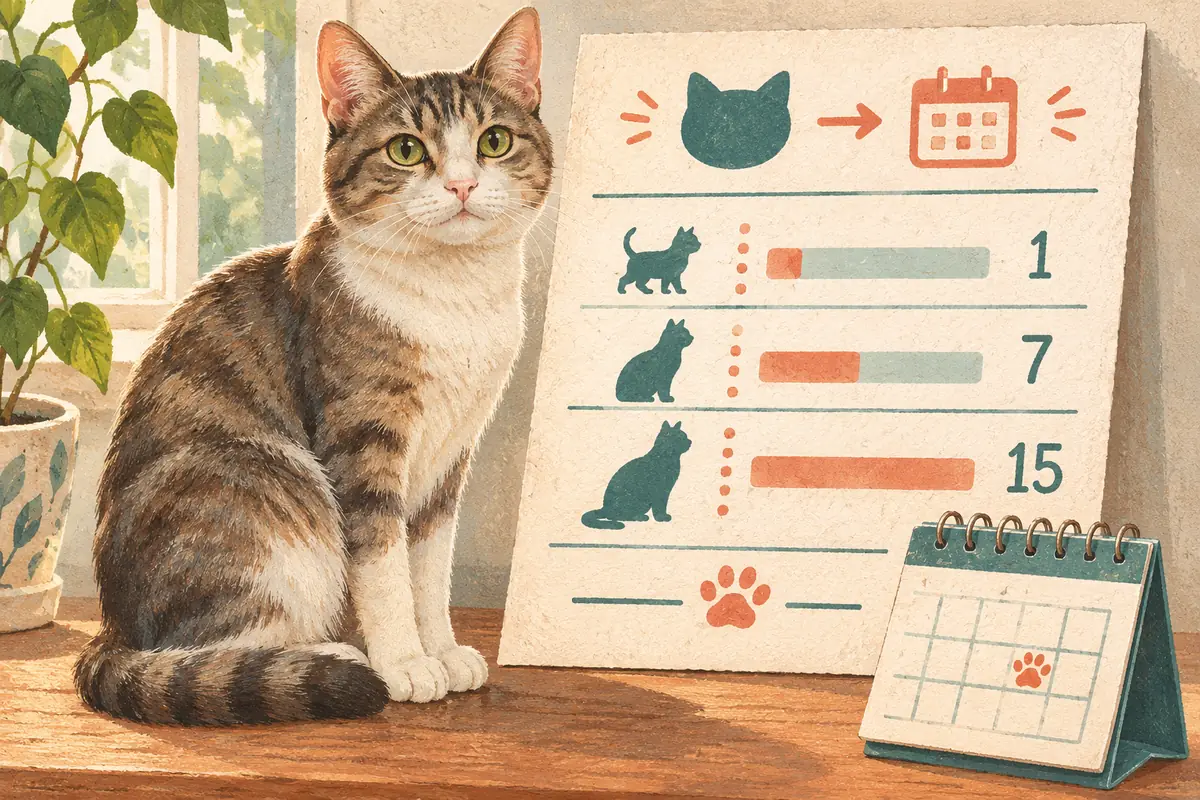
Short answer: the first two years move quickly, then add about four human years
A common veterinary comparison gives a one-year-old cat about 15 human years and a two-year-old cat about 24 human years in total. After age two, each full cat year adds roughly four human years, so age 3 is about 28, age 6 about 40, and age 10 about 56. These figures are a calendar comparison, not a measurement of biological age or health.
When reading a chart, record the real calendar age first, then name the method and say that the result is approximate. If the birthday is unknown, keep records and a veterinary estimate as separate evidence. A human-year number should never be the only basis for food, medication, vaccination, or treatment decisions.
What does a cat age calculator show?
A cat age calculator places two calendars beside each other. Cats develop faster than people during their first period of life, so a flat multiplier such as seven cannot describe the difference between one year and seven years. Early physical and behavioral maturity is rapid; later years are represented by a smaller yearly addition.
The practical purpose is to make a life-stage conversation easier. Saying that a six-year-old cat is roughly comparable to 40 human years can remind an owner that the cat is an adult and deserves consistent adult care. The same number cannot describe weight, activity, genetics, living conditions, or chronic disease in two different cats.
Keep three facts separate: calendar age, the human-year comparison, and actual health findings. A chart supplies only the second. If appetite, weight, mouth, movement, or behavior changes, do not explain the change away with a number; ask a veterinarian for an assessment.
- Record calendar age in years, months, and days as accurately as possible.
- Read the human-year number as an approximate communication aid.
- Base care decisions on the cat's own signs and veterinary guidance.
Why are the first two years calculated differently?
The first cat year is commonly matched to about 15 human years, while the second year brings the total to about 24. The additional nine belongs to the second year; a two-year-old cat is therefore calculated as 15 + 9, not as two times 15. This model describes the rapid development of kittenhood and young adulthood better than a single multiplier.
For cats older than two, a simple formula is 24 + (calendar age - 2) x 4. A five-year-old cat gives 24 + (3 x 4) = 36, and a ten-year-old gives 24 + (8 x 4) = 56. The result is a useful comparison line, not a complete biological measurement.
Some sources keep 15 and 24 for the first two years but give slightly different values at seven, ten, or fifteen. Differences can reflect life-stage definitions, samples, or chart assumptions. Choose one stated method, record its source, and do not combine rows from different charts into one apparently exact answer.
Cat age calculator chart
The cat age calculator chart below shows the common 15-9-4 approach at a glance. The rows for one and two years show the faster early pace; later rows add about four human years for each full cat year. Values between birth and one year change quickly, so the six-month row is only a broad orientation.
Do not use the human-year column as a care prescription. Two cats with the same calendar age can differ in body condition, diet, indoor or outdoor life, neutering history, and previous illness. Keeping the chart as a conversation starter is more responsible than making a decision from one row alone.
| Cat age | Approximate human age | General life stage |
|---|---|---|
| 6 months | About 10 | Kitten |
| 1 year | 15 | Young adult |
| 2 years | 24 | Young adult |
| 3 years | 28 | Young adult |
| 4 years | 32 | Young adult |
| 5 years | 36 | Young adult |
| 6 years | 40 | Young adult |
| 7 years | 44 | Mature adult |
| 8 years | 48 | Mature adult |
| 9 years | 52 | Mature adult |
| 10 years | 56 | Mature or later adult |
| 11 years | 60 | Later adult |
| 12 years | 64 | Later adult |
| 15 years | 76 | Senior |
| 20 years | 96 | Very advanced age |
How old is a six-year-old cat in human years? Worked examples
For a six-year-old cat, use 24 + (6 - 2) x 4. The four adult years add 16 human years, giving an approximate result of 40. This does not mean the cat has exactly the same health risks as a 40-year-old person; it is a clear way to describe the slower pace after the first two years.
For age ten, 24 + (10 - 2) x 4 = 56. For age fifteen, 24 + (15 - 2) x 4 = 76. Checking the arithmetic against the chart helps catch a mistake. Do not use the adult formula for a kitten under two; months and developmental milestones matter more in that period.
If you know the approximate birth season but not the day, write a range. For example, “born in summer 2020 and about six in summer 2026” is more honest than inventing an exact birthday. Update both the chart note and the veterinary record if a reliable date is later found.
- Age 6: 24 + (4 x 4) = about 40 human years.
- Age 10: 24 + (8 x 4) = about 56 human years.
- Age 15: 24 + (13 x 4) = about 76 human years.
How should you read month-based ages for kittens?
Estimating a kitten's months is a different task from converting an adult cat's calendar age to human years. Adoption records, dated weights, vaccine dates, old photos, and the pattern of baby teeth appearing or changing can help place a kitten in a broad developmental window. None of these clues gives a precise day by itself.
A kitten may be around one month, two months, or several months old while changing quickly in size, coordination, play, and feeding. The exact pace varies with nutrition, illness, genetics, and early care. Treat a month estimate as a range and tell the veterinarian which record or observation supports it.
If you look at teeth, do so only while the kitten is calm. Baby teeth or the transition to permanent teeth can provide a stage clue, but the examination setting and individual development make day-level dating impossible. Never force the mouth open or pull at a tooth.
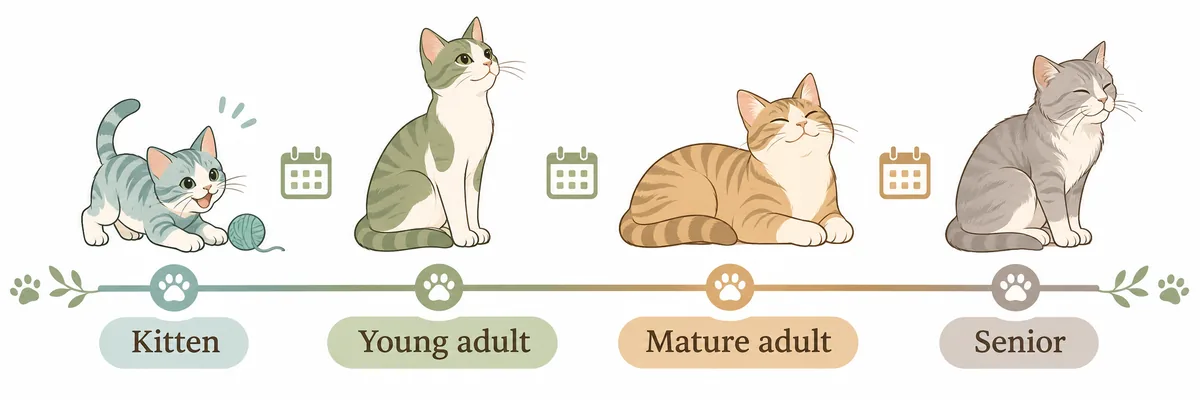
The AAHA and AAFP life-stage framework describes a kitten from birth to one year, a young adult from one to six, a mature adult from seven to ten, and a senior cat from ten years onward. These boundaries organize care conversations; they do not predict disease or lifespan on their own.
Do not treat the four stages as sealed boxes. Behavior, weight, and medical history can differ within the same stage. When a cat moves into a new stage, review routine checks, oral care, and weight tracking with a veterinarian rather than relying on the chart number.
- Support month estimates with records and an examination.
- Observe teeth only when the kitten is relaxed; never force the mouth open.
- Do not confuse a developmental stage with a health finding.
Why can life stage, breed, and health change the interpretation?
A cat age calculator places all cats on one general development line. An indoor cat and an outdoor cat may have different environmental pressures; breeds can differ in body structure; and past nutrition or illness can affect condition. Knowing the breed does not by itself predict future health or lifespan.
Weight, muscle, teeth, coat, movement, and behavior add context to the chart. They can also change because of pain, stress, disease, or a new environment. Do not dismiss weight loss, increased drinking, breathing changes, or hiding as “just age.” Those signs deserve a professional conversation.
A human-year equivalent and a life stage are not the same thing. Two ten-year-old cats may both receive the number 56; one may have stable weight and regular checks while the other may have oral pain. The first is a comparison, while the second calls for clinical assessment.
| Stage | Approximate calendar range | Topics to discuss |
|---|---|---|
| Kitten | 0-1 year | Development, socialization, vaccines, and nutrition |
| Young adult | 1-6 years | Weight, behavior, and preventive care |
| Mature adult | 7-10 years | Routine checks, oral health, and movement |
| Senior | 10 years and older | Individual monitoring and quality of life |
How can you use the chart safely in a care decision?
Take the human-year equivalent to a veterinary appointment as a note that gives the calendar age some context. Saying “ten years old, about 56 on this chart, and 300 grams lighter over the last two months” gives more useful information than simply saying “old.” The veterinarian will combine that context with an examination, records, and tests.
Do not use the human-year number alone for a food change, supplement, medicine dose, or vaccination schedule. A cat age calculator is not a care standard. Weight, previous illness, current signs, living conditions, and professional recommendations all matter. Avoid inventing exact thresholds that the cited source does not provide.
When sharing a chart result, include the method, the real calendar age, and the uncertainty range. That keeps one number on a social media card from becoming an unsupported health claim about the cat.
Which method should stay separate when a cat's birthday is unknown?
A cat age calculator gives a human-year equivalent only after a calendar age is known. If the birthday is unknown, first estimate a broad age range. Adoption paperwork, a microchip record, shelter notes, old photos, weight history, and tooth development may help; they do not become a conversion chart.
In an adult cat, tartar, eye appearance, or coat shine cannot provide a reliable birth date on its own. The same clue changes with diet, oral care, genetics, and health. Keeping a result such as “approximately five to eight years” is more defensible than declaring an exact six years without a record.
For that separate task, see our guide to estimating a cat's age when the birth date is unknown. That page explains how to read records, teeth, and physical clues cautiously; this article focuses on converting an already estimated calendar age into a human-year comparison.
Frequently asked questions about the cat age calculator
How do you calculate a cat's age in human years?
The common approach gives the first cat year about 15 human years and the second year a total of about 24. After age two, add roughly four human years for each full cat year. It is an approximate comparison and does not measure the cat's actual health.
How old is a six-year-old cat in human years?
With the 15-9-4 approach, a six-year-old cat is about 40 human years: 24 + (6 - 2) x 4. The number does not mean the cat has the same diseases as a 40-year-old person.
Is one cat year really seven human years?
No. Multiplying every year by seven misses the rapid development in the first two years. A chart that uses about 15 for year one and 24 for year two describes that change more clearly.
How can I tell how many months old a kitten is?
Use adoption records, dated weights, vaccine dates, photographs, and tooth development together. Teeth and appearance alone cannot give an exact month. Do not force a kitten's mouth open; share the uncertainty with a veterinarian.
Can a cat age chart guide food or medicine decisions?
No. The human-year equivalent is an explanatory comparison. Food, supplements, medicine, vaccines, and checkup timing should reflect the cat's weight, health history, current signs, and veterinary advice.
Sources
Main sources used to check the formula and life-stage boundaries:
- AVMA: Pet Ages Faster Than We Do — A veterinary information chart showing approximate human-age comparisons for cats and dogs.
- AVMA: AAHA/AAFP Feline Life Stage Guidelines — An explanation of kitten, young adult, mature adult, and senior feline life-stage boundaries.